Every poker hand tells a story, and it starts before the flop. Each bet, check and raise adds another sentence. When an opponent’s sentences don’t fit together, that’s your cue to pay attention. Sometimes it means a bluff. Sometimes it means a trap. Either way, a line that doesn’t add up is information you can use.
The Missing C-Bet
Say the cutoff opens and you call on the button. The flop is J♠-10♦-4♥, the cutoff checks, and you check behind. The turn is the 7♠, and now the cutoff leads for a third of the pot.
Should you be scared of the straight? Not really. A player holding 9-8 on that flop almost always continuation bets an open-ender. By checking the flop, the cutoff also took out their sets and two pair off the table. Their range is capped at one pair, and that’s exactly the kind of range you can pressure.
It works in reverse, too. If you want to represent the nuts, your earlier actions need to say you could have it.
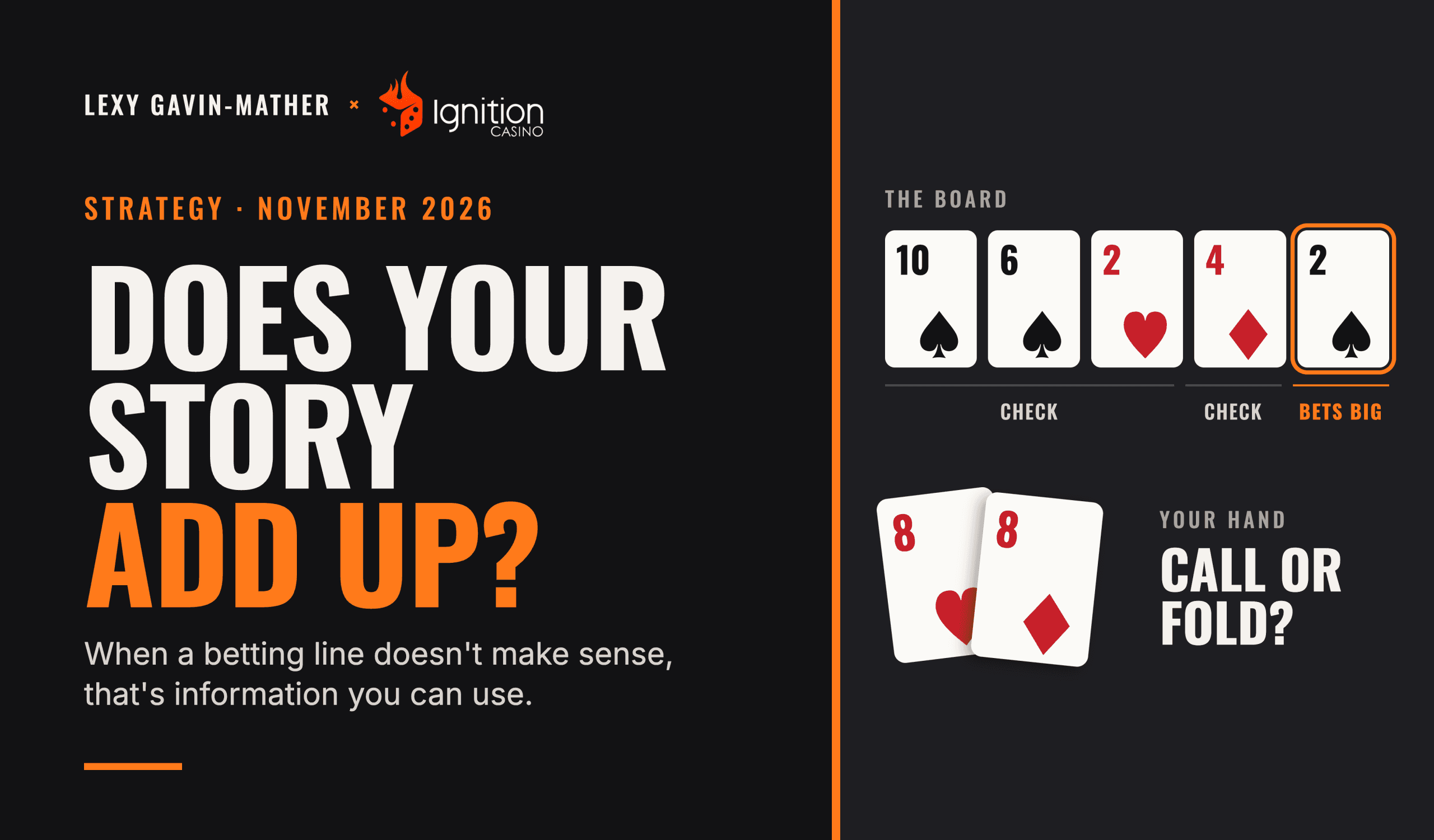
Hand Example: Calling Down With 8-8
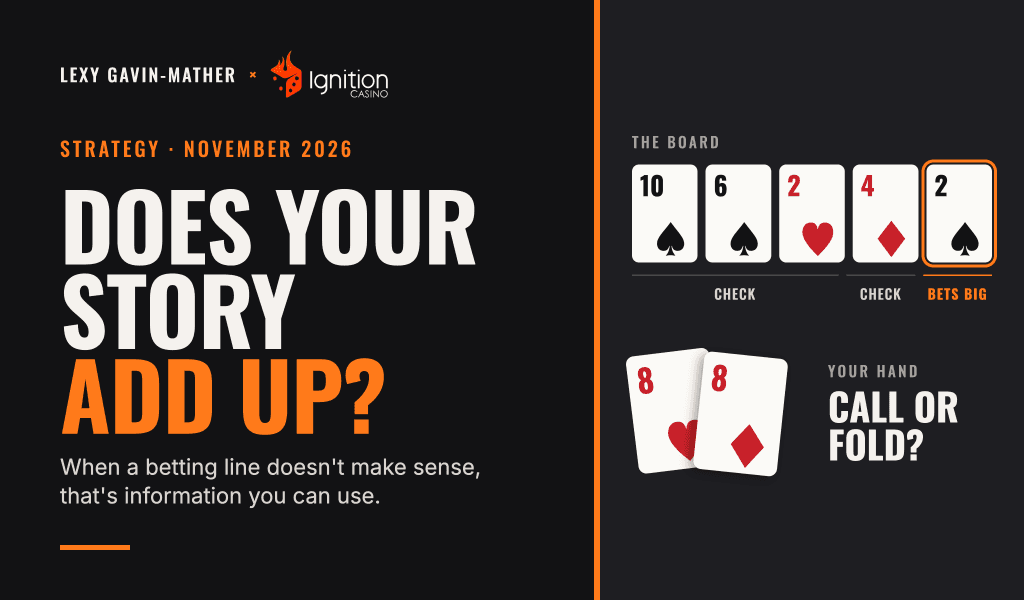
Blinds are 500/1,000 with a 1,000 big blind ante, and stacks are around 50 big blinds. A recreational player opens to 2,500 from the hijack, and you call on the button with 8♥-8♦. The blinds fold.
The flop is 10♠-6♠-2♥ with 7,500 in the pot. He checks, and you check back. Your eights have decent showdown value, and you’d rather not build a big pot with them. The turn is the 4♦. He checks again, you bet 3,000, and he calls.
The river is the 2♠, completing the flush. Now he leads for 12,000 into 13,500.
A big bet on a flush-completing river looks scary. But look at his story. Most players continuation bet their flush draws on a two-spade flop, especially as the pre-flop raiser, so his double check makes a flush unlikely. The same goes for overpairs and strong tens, which almost always bet the flop. And hands with a 2 for trips rarely open from the hijack.
So what does he have? Most of his check-call hands are things like ace-high or a weak pair hoping to get to showdown. When a scary card hits the river, some of those hands turn into bluffs, because the flush is the one hand that seems to fit a big bet. The problem is that his earlier actions don’t back it up.
You call. He shows A♣-Q♣, and your eights take the pot.
Folding would have felt safe, but that’s exactly what he was counting on.
The Takeaway
When an opponent’s line makes you scratch your head, trust that feeling and attack it. You’ll pick off more bluffs and fold out more confused hands. Just remember the table is reading you too. If your own line doesn’t make sense, your bluffs won’t get through against players who are paying attention.