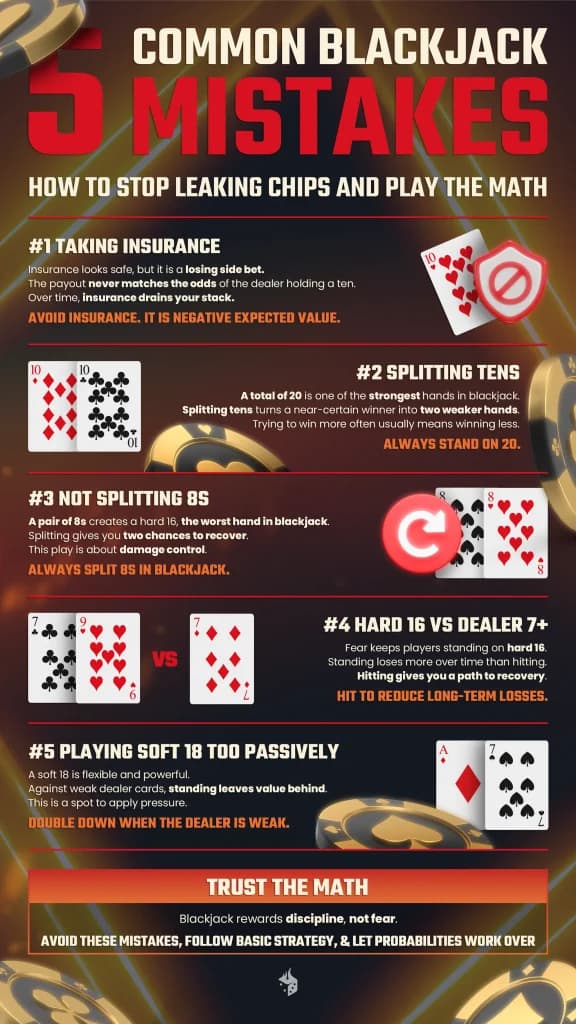

In blackjack, the cards dealt out are random. Anything can happen at the tables – cold streaks, hot runs, and everything in between. That’s why your blackjack strategy makes all the difference. It’s the one thing you can focus on to control outcomes. With optimal play, you can bring the house edge down below a single percent. The reason blackjack is so popular is that it’s one of the few games where the house and the player are nearly even. But if your game is full of leaks, the probabilities shift back in favor of the house again. It’s essential to avoid these 5 common blackjack mistakes to play your best game.
Mistake #1 – Taking Insurance
Insurance is a special bet that becomes available when the dealer shows an ace. Players are afraid that the dealer could flip over the down card and reveal a blackjack, so this bet became available for those who want to protect their hand from that outcome.
But it’s not a good bet.
Insurance pays 2 to 1 if the dealer has ten in the hole. In order for insurance to be the correct bet, the odds of the dealer having a ten must be better than 2 to 1. But that’s never the case. Especially if you’re holding ten-value cards, the dealer’s odds of holding one as well are less than one in three. There just aren’t enough cards in the deck to make the probability of this bet work. The long term expected value (EV) is negative. If you continually make this bet, you are virtually guaranteed to lose money in the long run.
Here’s another way to think of it. Insurance is a side bet on the dealer holding a ten card. The payout will never equal the chance of this happening, though. Just stay away from insurance in blackjack.
Mistake #2 – Splitting Tens
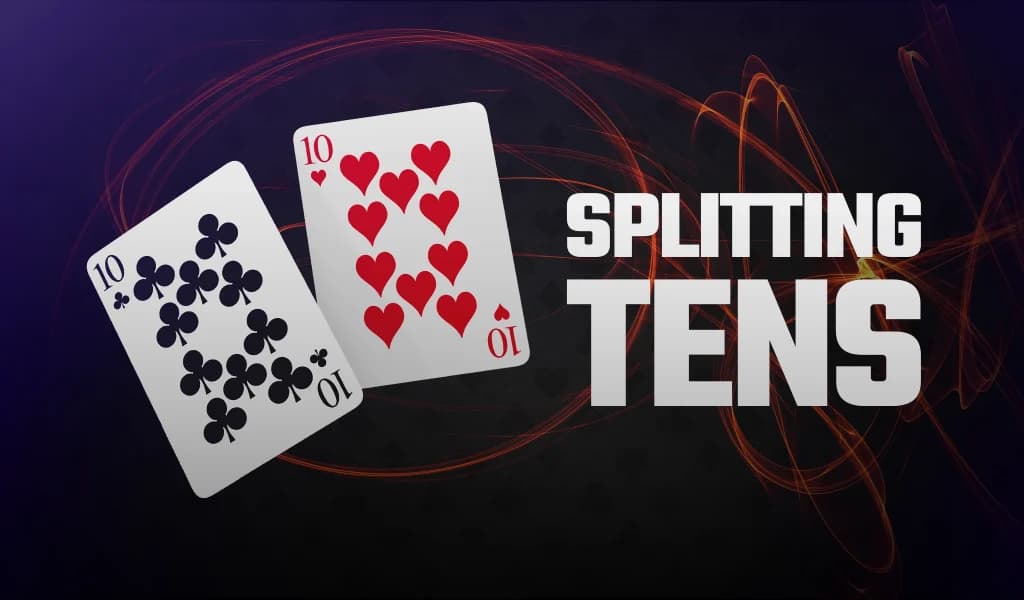
When you see tens, you might think, “Let’s win two hands instead of one,” right? The problem is, your win probability with 20 is very strong. In fact, you will win or push over 90% of the time. Throwing this opportunity away to try to build two other hands significantly decreases your odds of winning. You’re now trying to create strong hands from scratch. The mistake is that a strong hand is exactly what you just had. Make it pay and keep the tens together.
Mistake #3 – Not Splitting 8s
Most players know that the worst possible hand in blackjack is a 16. It’s hard to play, and none of the options seem very enticing. Standing feels too weak, while hitting feels to risky. This is especially true when the dealer has a strong upcard like a ten. You’d probably be considering hand surrender at that point.
Don’t back out yet. Enter loss minimization mode.
Splitting 8s is the best option to get away from a bad situation. It’s the opposite of the previous point. While tens are strong and should be kept together, 8s must be split to give you a shot at creating a more favorable hand. Your total of 16 was not great, but getting the 8s separated lets you put together something fresh. Don’t accept the loss, start over and always split those 8s.
Mistake #4 – Standing on a Hard 16 vs a Dealer 17
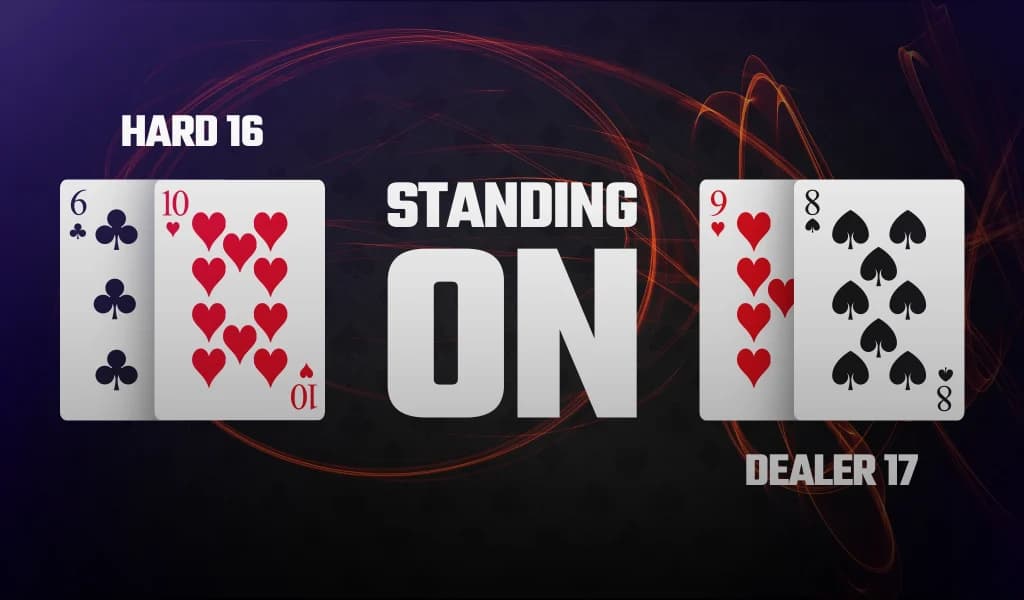
Here we are again – it’s another hand that makes players too scared to take a hit. The fear of busting has most players frozen at 16. But standing causes losses over the long run. It’s a negative EV play, and blackjack strategy demands that players find something better. As with the 8s, we need a play that loses less.
Five cards will actually help you. A-5 all are favorable, while others will send you into a bust. Believe it or not, the probabilities favor a hit here, despite the risk. Standing just doesn’t work out often enough to justify staying pat in this situation.
Mistake #5 – Not Playing Soft 18s Right
A soft 18 is made with an ace and a seven, and most players are happy to stand here. Surprisingly, this isn’t the right play.
Consider a hand where the dealer has a weak upcard, like a five. The dealer is running a significant risk of busting, and you’re in a spot where taking a single card can’t bust you. So what’s the right play?
Double down.
Increase your bet while the odds are in your favor, and you’ll be protecting your profit potential over the long run. The dealer must hit and is probably going to bust. You can put more money in play while the situation is favorable, and that’s smart blackjack strategy.