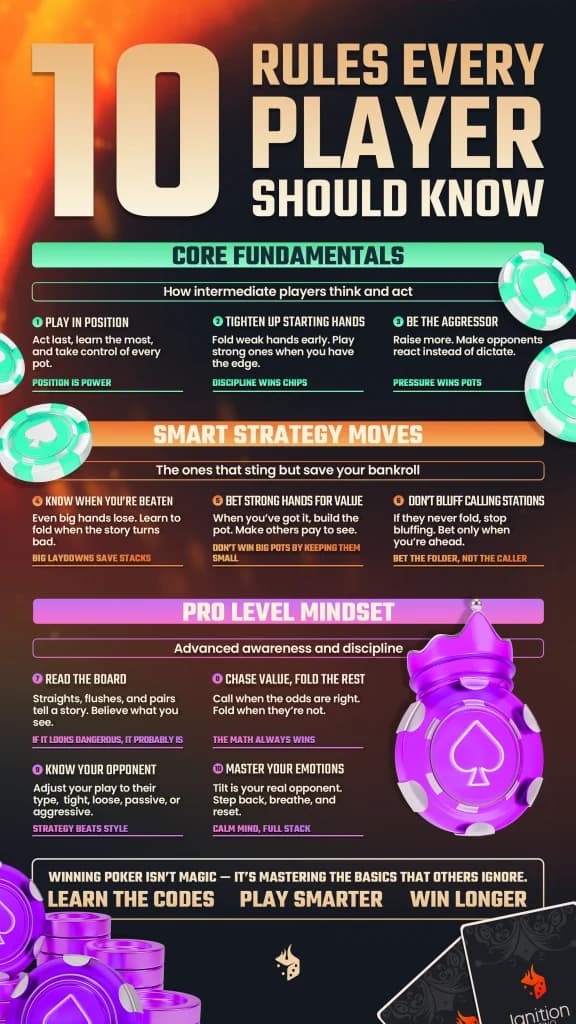

In poker, things can be really simple. People try to complicate the game, but many players are losing money due to very simple mistakes they are making. Below are ten poker cheat codes that every player should know to avoid leaks.
1. Play In Position
Cards can be enticing. You might look down at that A9s and think it’s time for a call preflop. But if you’re under the gun and first to act, you really need to think twice. Cards are really only playable in certain positions.
Position is one of the biggest advantages you can have. Being last to act in a hand of poker makes all the difference. That’s why the dealer button is king. You can play a much wider variety of hands there when compared to the blinds or early position seats of a 9-handed ring game. Most of your action should happen in the cutoff and button. You should be attempting to raise the blinds around half the time or more (in a passive game) from these locations.
Similarly, you don’t want to be playing from early position unless the cards justify it. Limping in from these seats almost guarantees that someone will raise you, and you will begin the hand poorer and in a worse position. Don’t let opponents abuse you in this way. Play smart and play in position.
2. Tighten Up Starting Hands
This next point is related to the first. Poker is about investing your chips into pots where you have the edge. This means that you’ll have to fold lots of garbage. You don’t want to put money into a pot with marginal cards – it’s going to cost you a lot of money in the long run. Know the hand rankings and have a feel for the Texas Hold’em starting hands charts.
Discipline can be boring, but it’s profitable.
3. Be Aggressive
Waiting for other people to hand you their chips is not a winning strategy. You will need to be the aggressor often if you want to win a hand. It’s not just about having the best hand at showdown. Long-term winners at poker know how to induce a fold. If you can get an opponent to fold, it doesn’t matter what either of you had. The pot is yours for the taking.
This means that when people limp, if you want to be in the hand, you should often raise. If they call your raises, they will often check the flop. This puts you in charge of the action, and lets you dominate the hand. You can put people to tough decisions, and make them play from the backfoot. It’s a very powerful way to make opponents fear being in a hand with you. And a scared opponent is often a losing opponent in poker.

4. Know When You’ve Been “Coolered”
Big hands get beat sometimes by even bigger hands. You need to know when to release your cards, even if they’re decent. Pocket queens, for example, look nice. That is, until the board shows A-K and more. Now you’re on struggle street. If passive players start betting or you get stuck between two active bettors, you need to fold. Hands like those just aren’t worth it.
The same is true when someone is passively calling while the board colors up with a single suit. Your warning lights should be flashing. Once the board shows three cards of a suit, you need to be very caution about putting money in with your premium top pair. It’s often going to be beat. A great poker player knows when to lay down a solid hand to avoid a probable loss.
5. Bet Strong Hands for Value
If you flop something as strong as a set, make opponents pay you. Don’t try to slowplay everything. Extract maximum value from other players when you have the goods. You’ll get paid handsomely by players with top pair. Players love to set traps, but sometimes a nice straightforward hand where you bet and raise with good cards is the way to go. The whole point of having standards is to know that you’ve got the best of a hand when you hit your cards. Force loose players to transfer you their chips and punish their bad, undisciplined play.
6. Don’t Bluff Calling Stations
There are players you can’t bluff because they’re not going to fold. They love being in a hand and always think they have a chance to win. No matter what chips go in, they’re probably going to call the bet. If you’re up against players like this, skip the bluffs. They don’t work. Bluff people who can feel fear and will fold. Trying to bluff a calling station is like arguing with a fish. They just don’t speak your language.

7. Read the Board
Be aware of draws as they take shape and land on the board. When straight and flush possibilities are both there, don’t keep firing your bets. Players love to hang around and try to hit draws. If you have a few players calling your hand, the chances are good that someone is chasing something. If a likely draw has hit, read the board and pump the brakes. What was true on the flop may not be true when the river finally arrives.
8. Chase Value and Fold the Rest
Call tiny bets when pot odds give you a reason to chase. Fold your hand when the odds are not worth it. If a player will let you see a turn card when you are four to a flush – for a bet that is 1/7th the pot – go for it. The odds demand a call there. On the other hand, if you have to call a pot-sized bet to chase your flush, the odds have become negative. Let the hand go.
9. Know Your Opponent
There are four basic types of players:
- Tight-Aggressive: These players focus on premium cards and are willing to bet and raise. Avoid them unless you have a strong hand.
- Loose-Aggressive: These players love to bet, no matter what they have. Just be patient. Let them bet into your good hands, and then clean up.
- Tight-Passive: These players are waiting for a monster hand, no matter how long it takes. Steal pots from them constantly, then dodge them when they wake up with a hand and start betting.
- Loose-Passive: These players just play way too many hands. Don’t bluff them. Bet for value and enjoy the profitable opportunities.
10. Master Your Emotions
Tilt is really the final boss of poker for many players. If you’ve just lost a big hand and are feeling steamed, you need to take a break. Your ability to lock in, focus, and play solid poker is temporarily broken. Cool off and don’t sit down to play poker until you feel that the frustration has subsided. If you don’t, you’ll be going all in with any two cards and doubling and tripling the damage to your stack.
Play the long game, and you’ll be playing to win.