
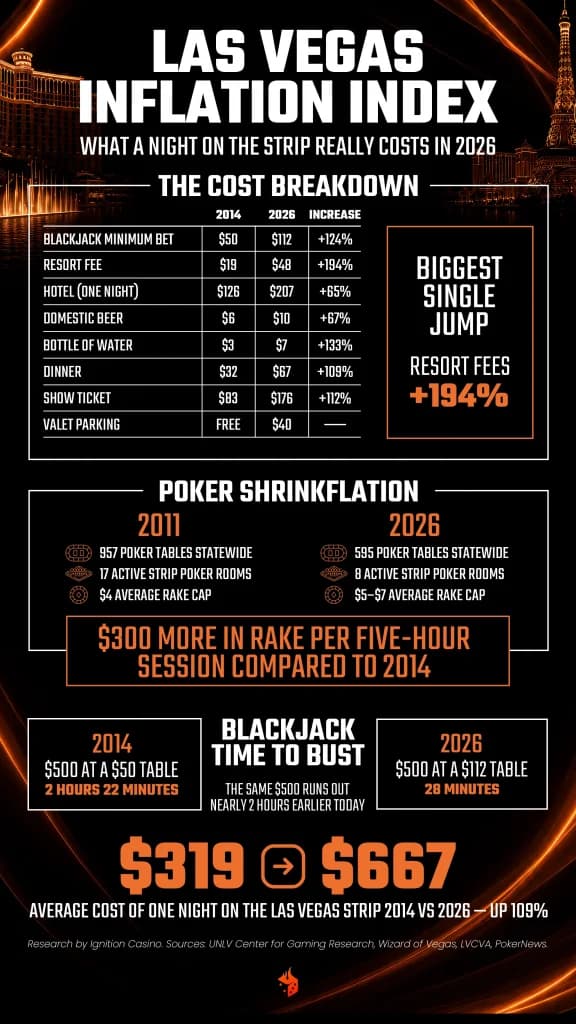
Cost of visiting Sin City for one night has more than doubled in the last 12 years.

- An average spend for one night on the Las Vegas Strip now reaches nearly $670, compared to $319 in 2014.
- Resort fees have seen a 194% rise in that period – the steepest increase of all.
- Nevada’s live poker table count has fallen by 38% since 2011 – from 957 tables to 595 – while the number of active Strip poker rooms has halved.
- Strip poker rooms are taking an average of $300 more per five-hour session compared to 2014.
- With a $500 blackjack budget, you will bust nearly two hours quicker on average in 2026 compared to 2014.
The average cost for a one-night stay in Las Vegas has risen by almost 109% in the last 12 years, as revealed by research from Ignition Casino.
Based on the average cost of a basket of a typical visitor’s stay – hotel, food, drinks, entertainment and parking – guests are spending nearly $350 more per night in 2026 than they were in 2014.
That basket includes the average minimum blackjack bet, a one-night hotel stay, resort fee, a domestic beer, bottle of water, dinner (entrée and drink), a show ticket and valet parking. All recorded prices are Strip averages in 2014 and 2026.
The steepest single increase is resort fees: the add-ons charged on top of base room rates averaged $19.43 on the Strip in 2014 and have risen to $48.49 today – a 194.5% jump. Almost every other line item has at least doubled, with blackjack minimum bets up 124%, water up 133%, show tickets up 112% and valet parking going from free to $40.
| Feature (On Strip) | 2014 | 2026 | % Increase |
| Blackjack minimum bet | $50.00 | $112.17 | +124.3% |
| Average resort fee/night | $19.43 | $48.49 | +194.5% |
| Weekend one-night hotel stay | $125.80 | $207.28 | +64.8% |
| Domestic beer | $6.00 | $10.00 | +66.7% |
| Bottle of water | $3.00 | $7.00 | +133.3% |
| Dinner (entrée + drink) | $32.00 | $67.00 | +109.4% |
| Show ticket | $82.86 | $175.91 | +112.3% |
| Valet parking | $0.00 | $40.00 | N/A |
| TOTAL | $319.09 | $667.85 | +109.3% |
But rising prices are only half the story. For poker players specifically, the cost of a Las Vegas trip has increased at the same time as the product itself has quietly contracted – fewer rooms, fewer tables, and higher costs per hand once you sit down. These combined pressures have pushed many recreational and regular players toward online poker, which offers lower costs, greater convenience, and around-the-clock game availability.
Fewer tables, higher rake: Las Vegas poker’s shrinkflation squeeze
Las Vegas remains the live poker capital of the world – but the infrastructure supporting that reputation has been quietly hollowed out, and the players who remain are paying significantly more for a shrinking product.
According to data compiled by UNLV’s Center for Gaming Research from Nevada Gaming Commission Quarterly Reports, the state’s live poker table count stood at 957 tables in 2011. By end-2025, that figure had fallen to 595 – a reduction of 38% over 14 years, with no return to pre-2016 levels in sight.
The decline is structural and predates COVID. From 957 tables in 2011, Nevada’s count fell steadily to 587 by 2018 as casinos converted poker floor space to higher-margin baccarat. The pandemic accelerated the attrition – tables collapsed to just 413 in 2020 – and the recovery has been incomplete. Today’s total of 595 remains roughly 38% below its 2011 level.
On the Strip specifically, the picture is even starker. From approximately 17 active Las Vegas poker rooms in the late 2000s, just eight remain today: Aria, Bellagio, Caesars Palace, Horseshoe, Mandalay Bay, MGM Grand, The Venetian and Wynn. For Texas Hold’em and Omaha players, this consolidation means less table availability and less competition between rooms – and with fewer operators competing for players, there has been little pressure to keep rake in check.
| Metric | 2011 | 2025/26 | Change |
| Nevada poker tables (statewide) | 957 | 595 | –38% |
| Active Strip poker rooms | ~17 | 8 | –53% |
| Average rake cap per hand | $4 | $5–$7 | ↑ significantly |
Are Las Vegas poker rooms still good value amid rising costs?
The rake compounds the shrinkflation picture. Of the eight active Strip rooms, Aria charges a rake of 10% of the pot up to a maximum cap of $7 per hand, Bellagio’s cap is $6, and the remaining rooms sit at $5. In 2014, the Strip average was 10% up to a $4 cap.
Considering a fast dealer pushes out 30 raked hands per hour, an extra $2 in rake per hand – at rooms where the cap is reached – means an extra $60 per hour going to the house. Over a five-hour session, that is $300 less in players’ stacks compared to 2014.
Factor in the broader 109.3% price hike across the average Las Vegas stay and there is a serious debate to be had over value for money. Players are paying more to stay, more to eat, more to park – and then paying more rake across fewer available tables once they sit down.
The same squeeze is visible at the blackjack tables, where minimum bet increases have made a given budget go significantly less far than it did 12 years ago – offering a precise illustration of what the broader cost increases mean in practice.
You will bust two hours earlier in Las Vegas today compared to 2014 with a $500 blackjack budget
The blackjack minimum bet increase tells a sharp story about what rising costs mean in practice. Based on the average Strip minimum in 2014, a $500 budget would last approximately two hours and 22 minutes before a player would be expected to bust against the house. Taking into account the 124% increase in average minimum bet since then, that same $500 would now be expected to last just 28 minutes.
This is calculated using a methodology applied by casino risk analysts and quantitative mathematicians, factoring in betting units, the standard deviation of blackjack (1.15, accounting for doubling down, splitting and natural blackjack payouts), and an average table speed of 70 hands per hour. Full methodology is set out in the appendix below.
| Budget | 2014 (hr:min) | 2026 (hr:min) |
| $100 | 0:06 | N/A |
| $200 | 0:23 | 0:04 |
| $300 | 0:51 | 0:10 |
| $500 | 2:22 | 0:28 |
| $1,000 | 9:29 | 1:53 |
Shrinkflation is usually associated with a chocolate bar that got smaller without the price changing. In Las Vegas, the same principle has played out across an entire recreational economy — only here, the price went up too. Fewer poker rooms, higher rake, steeper minimum bets and a resort bill that has more than doubled: the product has contracted while the cost of accessing it has soared.
Appendix: Blackjack time-to-bust methodology
The following explains how estimated survival times for a given blackjack budget are calculated, using the $500 at a $50 table example (median survival: 2 hours 22 minutes in 2014).
- Step 1: Normalisation. Currency is standardised into Betting Units. $500 / $50 minimum bet = 10 units.
- Step 2: Volatility Index. Standard deviation is defined. A simple coin-flip game has a standard deviation of 1.0; blackjack, with doubling down, splitting and 3:2 naturals, carries an accepted standard deviation of 1.15.
- Step 3: Absorbing Barrier Formula. Median hands to bust is calculated as: n ≈ 1.66 × (betting units)².
- Step 4: Executing the calculation. For 10 units: 10² = 100 × 1.66 = 166 hands to bust.
- Step 5: Translating to casino time. 166 hands / 70 hands per hour = 2.37 hours = 2 hours and 22 minutes. The same formula applied to a $112.17 minimum bet ($500 / $112.17 = ~4.46 units; 4.46² × 1.66 = ~33 hands; 33 / 70 = 0.47 hours = approximately 28 minutes.